
Recent observations from JWST have provided a revolution in chemical abundance measurements in the distant universe, enabling high-quality measurements of the abundances of multiple elements in galaxies out to z~12. These measurements have revealed unexpected abundance patterns in many galaxies, with some of the highest redshift galaxies showing significant excesses in nitrogen, while many star-forming galaxies at Cosmic Noon have shown deficiencies in other elements like sulfur and argon.
These abundance measurements provide unique constraints on the history of galaxy evolution, as different stellar populations synthesize different amounts of certain elements across their lifetimes. Many models have been proposed to explain the abundance measurements in the distant universe, including potential contributions from massive stars, core-collapse supernovae, Wolf-Rayet stars, AGB stars, very massive stars, and supermassive stars. Environments have also been suggested to play a role, with e.g. dense star clusters potentially impacting the measured abundance trends, and potentially linking the abundances measured in distant galaxies to the abundance variations seen in local globular clusters.
This workshop aims to bring together experts in chemical evolution across spatial and temporal scales, including stellar populations and yields, star clusters, local galaxies, and high-redshift galaxies. We will assess our current understanding of the variation and evolution of chemical abundances across cosmic time, and connect this understanding to key physical processes driving chemical evolution. We will aim to synthesize measurements and modeling efforts to create a community consensus on what are the primary drivers of chemical evolution over time. And we will determine key gaps where additional data or modeling could further distinguish between different evolution scenarios. We will publish our findings in a short series of peer-reviewed papers, to be submitted to a high-impact journal.
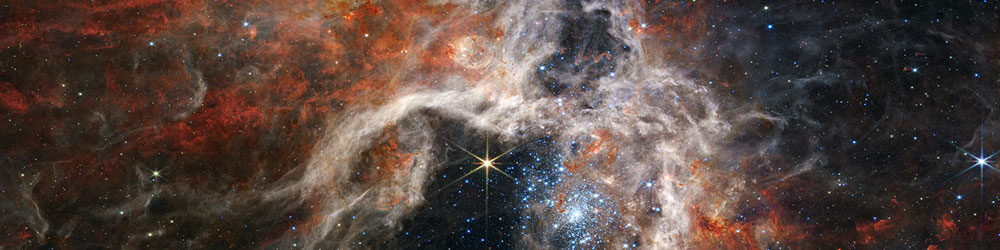
Header Image: Tarantula Nebula, 30 Doradus, 30 Dor, NGC 2070, Credit: NASA, ESA, CSA, STScI, Webb ERO Production Team